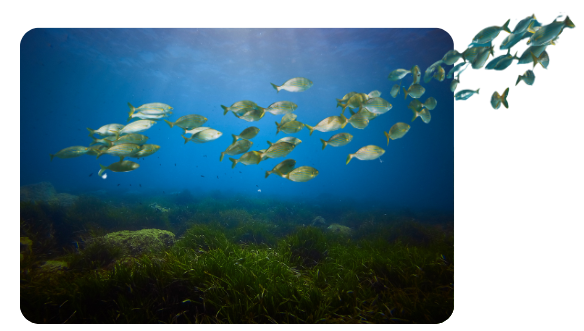
Our goal is to improve the sustainability of fisheries and aquaculture systems. Our science is helping to achieve this goal in several ways.
Firstly, we are improving the ways in which fisheries and aquaculture systems are monitored, for example, by developing innovative systems for detecting illegal fishing activity. Secondly, we are developing methods to better forecast future environmental conditions and the ways in which fisheries and aquaculture systems will respond, providing information to support management and policy. For example, we have developed ways to more accurately forecast harmful algal blooms that affect aquaculture farms and provided operational tools that enable managers to respond before these events occur.
We will reduce adverse activities or environmental risks and improve the sustainability of key marine industries, both at a national and international level, by providing operational tools that improve management and inform policy changes.
We can increase the sustainability, adaptability and equitability of fishing and aquaculture activities as well as the health and wellbeing of coastal communities by changing behaviours associated with the management of local fish stocks and the buying habits of consumers.
Our activities are described in these pages on:
- Food security and monitoring and forecasting of harmful algal blooms
- Optimising aquaculture and detecting aquaculture structures;
- Socio-economics of fisheries and aquaculture;
For example:
- Informing krill fishery management;
- Revealing illegal fishing activity;
- Monitoring and forecasting harmful algal blooms;
- Reducing the frequency of outbreaks of pathogens affecting aquaculture farms;
- Informing the development of marine protected areas based on climate-aware modelling of fisheries and vulnerable species.
-
 AgZero+ Towards sustainable, climate-neutral farming
Plymouth Marine Laboratory (PML) is a partner in a major five-year £13.8 million research programme, named “AgZero+’, to support the…
-
 Addressing Challenges of Coastal Communities through Ocean Research for Developing Economies (ACCORD)
The coastal and marine environments of South East Asia and the Western Indian Ocean (the regional foci of ACCORD) are…
-
 PRIMROSE: Predicting Risk and Impact of Harmful Events on the Aquaculture Sector
The aquaculture sector of Europe’s Atlantic Arc is negatively impacted by the effects of harmful blooms and microbial pathogens. The…
-
 S-3 EUROHAB – Sentinel products for detecting EUtROphication and Harmful Algal Bloom events
S-3 EUROHAB will use the latest satellite technology to improve the way water quality and harmful algal blooms (HABs) are…
-
 SOLSTICE-WIO: Sustainable Oceans, Livelihoods and food Security Through Increased Capacity in Ecosystem research in the Western Indian Ocean
SOLSTICE – WIO is a four year collaborative GCRF project that aims to strengthen capacity in the Western Indian Ocean…
-
 ShellEye
The ShellEye project will use Earth observation data from satellites and environmental data, such as weather forecasts, to monitor and…
- MSPACE
- NextOcean
- Safe and Sustainable Shellfish
- Scottish Karenia Watch
- Investigating the benefit of local eco-labelling scheme for seafood – work on the impact of the Cornwall Good Seafood Guide.
- Earth observation: detection of illegal fishing vessels; early warning of harmful algal blooms; mapping of offshore aquaculture structures; Ocean modelling: physical, ecosystem, shellfish growth, end-to-end fisheries;
- In situ observations: developing Antarctic zooplankton databases.